A.Vogel search
When the internal search is activated, personal data such as your IP address is transmitted to our search engine Cludo. Data is thus transferred to a third country. Please click here if you want to display the internal search. You can find more information on data protection here: Privacy policy.



Aesculus hippocastanum L
Common Horse Chestnut
History
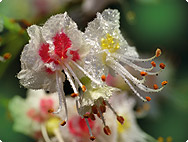
Analyses of lignite deposits show that, prior to the last Ice Age, the Horse Chestnut was indigenous to Central Europe. Then it was displaced to the south and spread through northern Greece, the Balkan mountain ranges, Asia Minor, and the Caucasus to the Himalayas. It did not return to Central Europe until the physician and botanist Karl Clusius (1526-1609) received horse chestnuts as a farewell present from the Turkish Sultan. In 1576, he planted them in the court garden in Vienna. Matthiolus (1565) produced the first drawing and description; he had received a branch of the fruit from Constantinople. But the tree did not become established in Central Europe until much later. Due to its stateliness, beautiful leaves and magnificent flowers we cannot imagine it not being present in our gardens and parks. The origin of the family name Aesculus is unclear. According to Linnaeus, it was the name for a species of oak. The species name hippocastanum means literally horse chestnut; it refers to the use of the seeds to treat coughing and broken wind in horses and to the fact that it is unsuitable for human consumption. But horse chestnuts are a popular winter feed for deer and wild boar. The Horse Chestnut was used medicinally in the treatment of haemorrhoids, uterine bleeding, vaginal and intestinal catarrh, chronic bronchitis, epilepsy, migraine and dizziness. It was an ingredient in powders used to treat nasal polyps. A widespread folk belief was that carrying Horse Chestnut seeds in one’s pocket would guard against gout, rheumatism and back pain.
Botanical characteristics
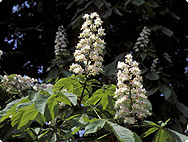
The Horse Chestnut is a stately tree 30 and 40 metres in height. It can live for up to 250 years and generally dies from wind damage. Its trunk is greyish-brown in colour, the bark being initially smooth and later scaly. Thick, conical, sticky, dark red buds appear in spring. The leaves, which are divided into five or seven leaflets, unroll from the buds and can reach up to 20cm in length. Young leaves are brownish red in colour and covered with down. After the down disappears, the leaves turn green and extend themselves in a horizontal position. More than a hundred individual white or reddish blossoms are usually grouped in the conical, erect inflorescence. The green, spiny fruits have a sturdy shell that bursts when the fruit is ripe. The fruit contains one or two glossy, dark brown seeds with a whitish top. The Horse Chestnut flowers from May to June. The unrelated edible Spanish chestnut or marron (Castanea vesca/sativa) belongs to the fagaceae (beech family).
Habitat
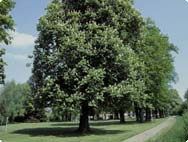
Through cultivation, the Horse Chestnut is widespread and can also be found growing wild. It is found at altitudes of up to 1200 metres in all temperate zones and prefers shady, moist sites.
Preparation
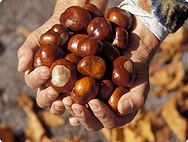
A.Vogel/Bioforce produces a tincture, a concentrated enteric-coated tablet and a homoeopathic trituration from the fresh seeds (chestnuts) which are gathered from the wild.
Extracts from the fresh shoot tips (gemmae) and flowers are also used medicinally. The leaves or bark are commonly used for the preparation of an infusion.
Horse Chestnut flour can be used to wash laundry (‘bolus soap‘), after removal of the tanning agents and saponins, as a baking flour, and for a wide variety of industrial applications.
Aescin is used in the cosmetic industry for gels, oil-in-water emulsions and, because it absorbs ultraviolet rays, as a sun-block.
Official designation
Horse chestnut seeds
Family
Hippocastanaceae
Synonyms
Aesculus castanea
Hippocastanum vulgaris GAERTN.
Common names
Conker tree
A.Vogel Venaforce® Extra - Horse Chestnut tablets for varicose veins
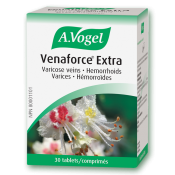
30 Tabs
To treat heavy and tired legs, like varicose veins and painful haemorrhoids.
More info
A.Vogel Blog – Natural and Healthy
Inspiration for a healthy life!
Alfred Vogel's guide to leading a healthy and happy life
Healthy & nutritious dinner ideas