A.Vogel search
When the internal search is activated, personal data such as your IP address is transmitted to our search engine Cludo. Data is thus transferred to a third country. Please click here if you want to display the internal search. You can find more information on data protection here: Privacy policy.


BPH (Benign prostatic hyperplasia)
BPH is the medical term for the condition commonly known as an enlarged prostate.
Our experts explore enlarged prostate problems causes, as well as risks factors. You can also use our Q&A service to ask a question about enlarged prostate.

Prostate 1 - Saw Palmetto capsules for enlarged prostate
Prostate 1 prevents and relieves benign prostate hyperplasia (BPH) symptoms. Only 1 capsule a day. All symptoms improved by 40% after only 8 weeks
BPH (Benign prostatic hyperplasia or hypertrophy) is the medical term for the condition commonly known as an enlarged prostate. The problem is commonly encountered and symptoms are classified as:
- Irritative symptoms - a need to urinate frequently, nocturia (having to get up at night to urinate), a feeling of incomplete emptying
- Obstructive symptoms – poor stream, hesitancy (stopping and starting), dribbling at the end of urination.
Doctors have known for a long time that the degree of prostate enlargement does not always correlate to the level of symptoms experienced. BPH-like symptoms can be present even if there is no evidence of prostate enlargement.
The word hyperplasia indicates an increase in the number of cells. Hypertrophy refers to an enlargement or increase in size of an organ or tissue.
Hence, benign prostatic hyperplasia is the term used when cell numbers in the prostate increase. This may then lead to an increase in the size of the prostate and so, the term benign prostatic hypertrophy is also appropriate.
You will find both terms used, although experts would suggest that benign prostatic hyperplasia is the more correct one.
We don’t really understand the cause of BPH, but what we do know is that as a man becomes older, prostate cells become more sensitive to the testosterone known as DHT (dihydro-testosterone) circulating in the body.
Prostatic cells react and respond by dividing and multiplying (the hyperplasia mentioned above) and this causes the prostate to enlarge. However, the enlargement in itself does not always explain why BPH symptoms occur:
- Mildly enlarged prostate glands can lead to severe symptoms, including obstructive symptoms making it difficult or nearly impossible for a man to urinate comfortably
- Very large prostate glands on the other hand, have been found in men who complain of no or few symptoms.
It is suggested that apart from responding to DHT by growing more cells, inflammation is present in prostatic tissue. This leads to an irritation or disturbance of nerve function in the bladder as well as at the junction of the bladder and the prostate (known as bladder neck) which controls the flow of urine.
As we don’t fully understand why BPH occurs, risk factors described by prostate experts and doctors are based on empirical observations. These include:
- Increasing age
- Being of African or Afro-Caribbean descent
- Being overweight
- Lack of physical activity
- Having erectile dysfunction – although it is not clear if it is BPH which is the cause
- Family history of BPH
In general, BPH is a relatively benign condition even if severe symptoms are present. However, complications can occur and these bring about secondary problems which may sometimes be serious:
- Cystitis / Bladder infections / UTIs. If incomplete emptying of the bladder is present, a residue of urine forms in the bladder and this ‘sump’ will have a tendency to become infected. Hence, although it is rare for a younger man to suffer from a urinary tract infection or cystitis, it is not so uncommon in one older and when this occurs, it would normally suggest BPH.
- Acute retention of urine. This may be seen in both previously diagnosed or undiagnosed BPH. Decreasing ability or inability to urinate, increasing discomfort, abdominal swelling, tenderness and pain are the key signs. The introduction of a catheter into the bladder brings about quick relief
- Chronic retention of urine. Sometimes, a man does not know that he has a problem with his prostate despite the fact that he has difficulty urinating. Over time, urine builds up and the bladder becomes desensitised. This allows even more urine to build up in the bladder and over months or years, a backflow of urine into the kidneys can damage these important organs in the body
- Hernia. Prolonged and repeated straining when urinating can lead to breaks in various parts of the abdominal wall.
A clinical study showed the exceptional efficacy of Prostate 1 Sabalasan:
- 80 to 88% of patients showed a marked reduction of overall BPH symptoms.
- Nocturia (excessive urination at night) decreased by more than 50%.
- The volume of residual urine was clearly reduced by up to 60%, while urinary flow increased by an average of 6.1 mL per second1.
- Another benchmark study compared the efficacy of finasteride (conventional medication) against Prostate 1 Sabalasan®.
Both treatments EQUALLY decreased symptoms; however only Prostate 1 Sabalasan had no side effects2.
Take a minute to check the health of your prostate.
Prostate 1 - Saw Palmetto capsules for enlarged prostate
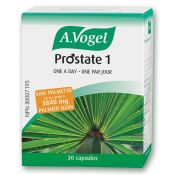
30 Caps
Herbal medicine to relieve urologic symptoms associated with mild to moderate benign prostatic …
More info
Popular Q&As
I have been diagnosed with an enlarged prostate, and have been prescribed Finasteride, which is giving me horrible side effects. Can you give me some info on your product? I have tried another herbal product but again this gave me severe stomach problems.
Saw Palmetto has been traditionally used for the relief of symptoms of an enlarged prostate.
Side ...
Read more
I have just had the left lobe of my prostate removed and was chatting to a friend who suggested I try Saw Palmetto to help with the release.
You need a definite diagnosis of enlarged prostate before taking Saw Palmetto.
It is important to ...
Read more
A.Vogel Blog – Natural and Healthy
Inspiration for a healthy life!
Alfred Vogel's guide to leading a healthy and happy life
Healthy & nutritious dinner ideas